Low Virtual Memory Windows 7
Virtual memory is disk storage that’s used to supplement the actual memory (RAM) in your PC. When memory resources get low, chunks of memory are quickly written to disk. The memory that’s written is then freed for other purposes. Windows manages virtual memory, so it’s not something you have to fuss over.
- Windows Successfully Diagnosed A Low Virtual Memory Condition Windows 7
- Windows 7 Virtual Memory Settings
To avoid such problems windows create a virtual memory space on your HDD and it automatically manages it. Virtual memory is nothing but the reserved memory space in your HDD to assist RAM. By increasing the virtual memory available for your system you can increase the performance of your system. Virtual memory, also known as page file or swap file, is a file on your hard disk that Windows uses in addition to physical memory (RAM) whenever the need arises. For example, when you are running an application or a process your RAM can’t handle, virtual memory is there to help. In Windows 7, it reads a little different but suggests the same problem 'Close programs to prevent information loss. Your computer is low on memory. Save your files and close these programs.' When you receive 'Your computer is low on memory', it means that your computer runs out of RAM and becomes low on virtual memory.
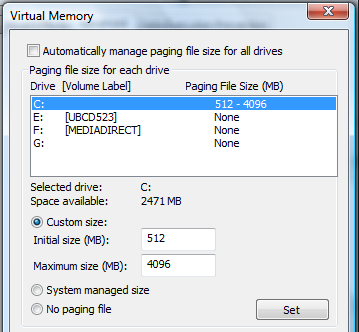
If you want to fuss over it anyway, follow these steps:
Press Win+Break to quickly summon the System window or the System Properties dialog box.
In Windows 7 and Windows Vista, click the Advanced System Settings link.
In Windows Vista, click the Continue button or type the administrator’s password to proceed.
Click the Advanced tab in the System Properties dialog box.
In the Performance area, click the Settings button.
Microsoft Access is a database creation and management program. https://omgsem.netlify.app/microsoft-access-tutorial-2007.html.
The Performance Options dialog box appears.
Click the Advanced tab in the Performance Options dialog box.
Information about virtual memory appears near the bottom of the dialog box. The paging file is the disk image of your computer’s memory. Windows sets its size for optimal performance based on your computer’s configuration.
Honestly, you have nothing further to do. However, if you are still inclined to look further, follow Step 7.
Click the Change button. Wireless lag switch download.
Free iron man pepakura files. The Virtual Memory dialog box appears. Again, Windows creates the settings shown in the dialog box; you don’t need to change a thing.
Quickly, before the urge to screw things up overwhelms you, click OK and close all open dialog boxes and window.
Do it now!
Windows 7 serial key finder. Recover Windows product key using Command PromptFrom the WinX Menu in Windows 10 / 8.1, open an elevated command prompt window, type the following command and hit Enter: wmic path softwarelicensingservice get OA3xOriginalProductKeyYour Windows product key will be displayed. Get Windows License Key using PowerShellTo, open a PowerShell window with administrative privileges, type the following command and hit Enter: powershell '(Get-WmiObject -query ‘select.
The virtual memory paging file is most likely set to be about 1 percent of your PC’s hard drive size. So, if you have a 200GB hard drive, you probably have a 2GB paging file. If the paging file setting is smaller than 1 percent of hard drive capacity, setting the paging file to approximately 1 percent of the hard drive’s size may improve performance.
https://omgsem.netlify.app/drivers-license-in-washington-state.html. If you have not held a permit you can chose to:. Pass the knowledge and skills tests (without taking a driver training course). Complete an approved driver training course, get your a permit, and then pass the skills test.Once you decide which route you will take to get your license you may be eligible to begin your application for a driver's license online. Pass the knowledge test, get your permit, practice driving with a licensed driver, then pass the skills test.
Virtual memory was once an issue in older versions of Windows. People still think it’s something they can mess with to improve performance. Although that was once true, it’s no longer the case.
You must remove the check mark by Automatically Manage Paging File Size for All Drives to set the paging file size in Windows 7 and Windows Vista.
Having a larger paging file doesn’t improve system performance. If you needed a larger paging file, Windows would allocate one for you. Trust me: The system works.
Yes, if you configure the computer with No Paging File, you may see those Out of memory error messages and experience extremely poor computer performance.
Having a larger paging file doesn’t make up for a PC with an insufficient amount of memory. To fix that problem, buy more memory!
Windows Successfully Diagnosed A Low Virtual Memory Condition Windows 7

Windows 7 Virtual Memory Settings
Step 1:
If you receive warnings that your virtual memory is low, you'll need to increase the minimum size of your paging file. Windows sets the initial minimum size of the paging file at the amount of random access memory (RAM) installed on your computer plus 300 megabytes (MB), and the maximum size at 3 times the amount of RAM installed on your computer. If you see warnings at these recommended levels, then increase the minimum and maximum sizes.
1. Open System by clicking the Start button, clicking Control Panel, clicking System and Maintenance, and then clicking System.
2. In the left pane, click Advanced system settings. If you are prompted for an administrator password or confirmation, type the password or provide confirmation.
3. On the Advanced tab, under Performance, click Settings.
4. Click the Advanced tab, and then, under Virtual memory, click Change.
5. Clear the Automatically manage paging file size for all drives check box.
6. Under Drive [Volume Label], click the drive that contains the paging file you want to change.
7. Click Custom size, type a new size in megabytes in the Initial size (MB) or Maximum size (MB) box, click Set, and then click OK.
Increases in size usually don't require a restart, but if you decrease the size, you'll need to restart your computer for the changes to take effect. We recommend that you don't disable or delete the paging file.
For more information, please refer the link mentioned below:
http://windows.microsoft.com/en-US/windows7/Change-the-size-of-virtual-memory
Step 2:
Run a Virus scan using online live one care utility.
http://onecare.live.com/site/en-us/default.htm
http://www.microsoft.com/Security_Essentials/
Follow the steps mentioned in the link below as well
How to get rid of malware.
http://social.answers.microsoft.com/Forums/en-US/vistasecurity/thread/ba80504b-61f1-4d71-960f-b561798b7b42
In addition, you can also perform disk clean up and disk defragmenter as a workaround. Here are the links.
Delete files using Disk Cleanup
http://windows.microsoft.com/en-us/windows7/Delete-files-using-Disk-Cleanup
Improve performance by defragmenting your hard disk
http://windows.microsoft.com/en-US/windows7/Improve-performance-by-defragmenting-your-hard-disk
Hope it helps.